Local Information
History
Information about the local History
A little introduction
The parish of Welford extends over 5,000 acres and includes the larger villages of Welford and Wickham plus the smaller villages of Weston, Easton, Hoe Benham and Halfway. The nature of the geography has always tended to fragment the parish. It extends for five and a half miles from north to south between Leckhampstead and the Great Western railway line in the south, and for an average of two miles between Shefford Woodlands in the west to Boxford in the east. The parish is further dissected by the River Lambourn which runs through Weston, Welford and Easton on its way to join the Kennet at Newbury, and also by the River Kennet and the canal below Halfway; thus it has no overall focal point. Three major roads pass through the area:
- The B4000 roughly follows Ermin Street, to Baydon. Ermin Street was built by the Romans in the 1st century as the road between Silchester and Cirencester. Wickham was a day’s march from Silchester and thus, an important junction. Minor roads led to the Bath Road and Littlecote.
- The A4 London to Bath road – always known as the Bath Road – had an important stopping point at Halfway for stagecoaches, in the 17th and 18th centuries. The tollgate, just west of the Halfway Inn was sadly demolished in the 1960s.
In 1971 the M4 cut its way through the widest part of the parish via Easton, Welford and Wickham, on its east/west route.
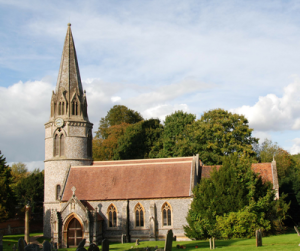
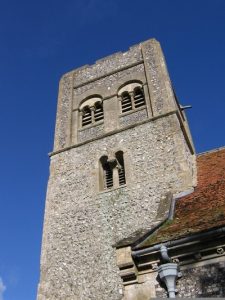
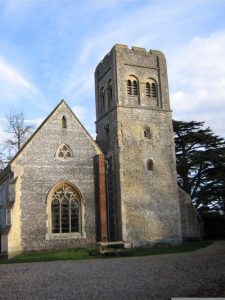
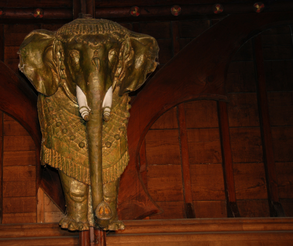
Famous Papier Mache Elephant located in Wickham Chapel
Wickham chapel is most famous for its papier mâché elephants in the roof of the north aisle. These were purchased by the rector at the Paris exhibition in 1862. There were originally three, which he meant to display in the rectory (now Wickham House) but unable to find anywhere suitable to put them, he had more made and placed them in the church giving them names such as Fortitude, Docility and Strength – all good Victorian virtues! They were originally gilded and must have looked very impressive. Over time they have become somewhat tarnished – many people travel from afar to see these elephants.
Welford House (now Welford Park) was built on the site of a minor monastery, one of the many that came under the control of the Abbot and monks of Abingdon Abbey. It was a favourite place for the abbots to stay with a plentiful supply of fish, from the large hand-dug fishponds, as well as game from the forests. On the dissolution of the monasteries in 1536, Henry VIII kept Welford as a personal hunting lodge and estate. In 1546 it was leased to Sir Thomas Parry. His son, another Sir Thomas, sold the property to Sir Francis Jones, Lord Mayor of London. In 1680 Mary Jones, the great granddaughter of Sir Francis (and sole heiress) married John Archer. The present house was built in 1702 and the estate of about 3,000 acres has passed down through the family to the present owners, Mr and Mrs James Puxley, through male and female lines and with a few name changes. For 50 years the grounds have been opened for snowdrop days; takings from the four Sundays in February are generously donated to local charities.
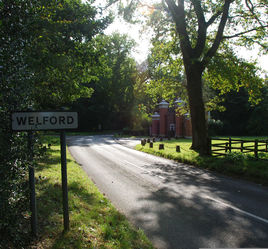
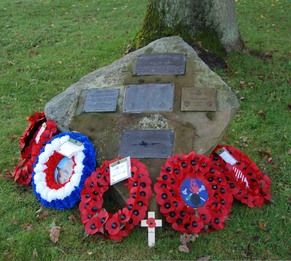
During the 2nd World War, 600 acres were commandeered to form Welford airbase and were occupied by the American 101st Airborne Division. The base was visited by Sir Winston Churchill and General Eisenhower to witness a practice parachute drop, prior to the Normandy invasion. On the night of 31st March 1944 the eight man crew of Lancaster Bomber DV290 were on their way back from a raid on the German town of Nuremberg. At some point, the crew saw the lights of Welford and, probably not having an operational radio, decided to land unannounced. As the aircraft lined up on the runway the lights were extinguished believing the un-announced aircraft to be German. The result was that the aircraft struck the runway and the fuel tanks exploded, destroying the aircraft and killing all the crew. In 2000 permission was given to create a memorial, in memory of the crew, in the station memorial garden. This was subsequently officially dedicated and many of the families of the crew were present. The base is now jointly used by British and US forces. Underground silos on the base have been used for the storage of conventional arms.
Love to read more?Local Historian Enthusiast, Bob Chandler, used to regularly write for the Parish Magazine. Once Covid restrictions have lifted Bob hopes to set up a new history group who can meet socially a few times a year to discuss topics of interest.
|
Have some past to share?Bob is always keen to hear from others, with photos and memories. If you have some stories to share, then please email Bob.
|